PUBLIC RELEASE SOURCE REVIEW · INDEPENDENT ANALYTIC CASE FILE
CASE FILE 68 / 237UAP00385
237UAP00385
Radar/correlation-focused public UAP report; score 52
NORMAL-OBJECT FAVORED
Report No.
UAP-OM-68-237UAP00385
Disposition
NORMAL-OBJECT FAVORED
Primary Case
237UAP00385
Generated
2026-05-20 18:32 UTC
Report Time
2024-10-22T01:54:00+00:00
Observer
38.85440, -78.20560
Source Case IDs
237UAP00385
Abstract
This case file evaluates a reported UAP sighting against historical Starlink orbital elements. The primary external-object candidate is a 3-object same-launch group from 2021-04-07, spanning azimuth 334.96-356.89 deg and elevation 10.64-18.83 deg. The analysis distinguishes plausible geometric overlap from unresolved witness-language features.
This is a standalone independent analysis prepared from public-source records and public orbital datasets. It is not an official government determination, classification marking, or agency-authored report.
1. Executive Summary
237UAP00385 is assessed as normal-object favored because the available public evidence gives a case-specific ordinary-object candidate: strong ADS-B aircraft candidate N957NK A20N ad4fde at 0.5 km, azimuth 57.6 deg, elevation 86.57 deg, 6.87 min from report. Dense satellite presence alone is not treated as causation in this packet.
1.1 Key Findings
Source score 52 based on: radar/primary-return language, high-altitude report, UAP/UFO language.
Report time used: 2024-10-22T01:54:00+00:00.
External object layer used: Starlink.
Disposition standard: NORMAL-OBJECT requires case-specific causal fit. Satellite density above the horizon is context only and cannot by itself resolve the report.
Case-specific ordinary-object evidence: strong ADS-B aircraft candidate N957NK A20N ad4fde at 0.5 km, azimuth 57.6 deg, elevation 86.57 deg, 6.87 min from report.
Non-causal context / rejection screens: very dense orbital-object sky background; context only, not causation; NASA/JPL known-small-body rejection screen present.
Objects above horizon: 325; at/above 10 deg: 149.
Top compact same-launch/designator group: 3 objects from 2021-04-07.
No explicit Starlink/balloon wording was found in the source excerpt used for ranking.
1.2 Bottom Line
NORMAL-OBJECT FAVORED: A case-specific ordinary-object candidate exists from source language, orbital geometry, launch-object context, or compact trajectory grouping. Dense ordinary sky traffic alone is not treated as causation.
2. Source Control
The source-control table identifies the public report records reviewed for this case and lists public access links where available. The table is included so this PDF remains interpretable when distributed by itself.
Aircraft reported an unidentified aerial phenomenon off the left side while SW bound at FL360, over LDN. The unknown phenomenon was bright white and yellow flashing lights, stationary at approximately FL500 to FL600. The UAP was not observed on ATC facility radar system.
Report time used
2024-10-22T01:54:00+00:00
Observer coordinate used
38.85440, -78.20560
Observer source basis
aviation_fix:over LDN (public text extract 237UAP00385)
4. Methodology
Spacetime extraction. The report time and observer coordinate were extracted from the public text report and normalized to UTC. Aviation fixes/radials were resolved during earlier preprocessing where applicable.
External object dataset. The object layer used historical Space-Track/TLE-derived Starlink element rows. The analytic mode for this case is historical Starlink element propagation and same-launch/designator sky grouping.
Propagation. Orbital elements were propagated to the report minute and observer location. For launch-object checks, samples around the report minute were retained. For Starlink group checks, objects above the horizon were clustered by sky position and filtered for same-launch groupings.
Comparison. The output was compared against the report's count of lights, direction cue, motion language, altitude/radar language, and whether the file itself already suggested a satellite explanation.
Causation standard. Mere object presence above the horizon is treated as background context only. A normal-object disposition requires a case-specific causal fit, such as a named launch object, a compact same-launch trajectory group, or source language that directly supports that object class.
Disposition assignment.Identified means a specific normal object fits the report spacetime and the hard reported features do not materially conflict. Normal-object favored means a case-specific ordinary aerospace/orbital candidate exists, but it is not a full named identification. Insufficient means the file is too thin to carry high anomaly value. High-value unresolved is used when radar, video, rapid maneuver, or multi-witness features remain after reasonable normal-object checks.
5. External Object Evidence
5.1 Search Volume and Density
This table is a screening layer only. Objects above the horizon show background opportunity; they do not establish causation unless a specific object or compact trajectory group matches the reported behavior.
Starlink catalog IDs considered
6473
Historical element rows
6452
Above horizon at report minute
325
At/above 10 deg
149
Largest same-sky cluster
120
5.2 Same-Launch / Same-Designator Candidate Groups
#
Launch Date
Count
Azimuth Span
Elevation Span
Motion Labels
Members
1
2021-04-07
3
334.96-356.89 deg
10.64-18.83 deg
eastward, setting
STARLINK-2478, STARLINK-2476, STARLINK-2485
5.3 Primary Group Members
Object
NORAD
Launch
Az
El
Range km
Apparent Motion
Element Age h
STARLINK-2478
48135
2021-04-07
334.96
18.83
1344.07
eastward, setting
4.47
STARLINK-2476
48134
2021-04-07
356.89
15.06
1519.37
eastward, setting
2.85
STARLINK-2485
48142
2021-04-07
347.45
10.64
1778.94
eastward, setting
2.8
5.4 Bright-Sky Context: Top Starlink Objects by Elevation
Space-Track SATCAT metadata was pulled as a cached subset for NORAD catalog IDs appearing in this packet's evidence tables. This section adds owner/type/status context to the propagated object candidates.
Packet SATCAT subset rows
5370
Fetched
2026-05-19T01:19:50+00:00
This case NORAD IDs checked
33
SATCAT rows matched
33
Top owners
US: 33
Object types
PAYLOAD: 33
5.7 Space-Track Metadata for Top Propagated Objects
NORAD
Object Name
Type
Owner
Launch Date
Decay Date
58061
STARLINK-30579
PAYLOAD
US
2023-10-13
n/a
46077
STARLINK-1559
PAYLOAD
US
2020-08-07
n/a
60929
STARLINK-11240
PAYLOAD
US
2024-08-31
n/a
47736
STARLINK-2147
PAYLOAD
US
2021-03-04
n/a
53004
STARLINK-4253
PAYLOAD
US
2022-07-07
n/a
58012
STARLINK-30525
PAYLOAD
US
2023-10-05
n/a
52353
STARLINK-3807
PAYLOAD
US
2022-04-29
n/a
59082
STARLINK-31286
PAYLOAD
US
2024-02-29
n/a
57951
STARLINK-30399
PAYLOAD
US
2023-09-25
n/a
55998
STARLINK-5902
PAYLOAD
US
2023-03-24
n/a
56923
STARLINK-5952
PAYLOAD
US
2023-06-12
n/a
55623
STARLINK-5698
PAYLOAD
US
2023-02-12
n/a
5.6 NASA/JPL Near-Earth Object Screen
This secondary object screen checks NASA/JPL close-approach objects near the report date and propagates their observer geometry through Horizons at the report coordinate. It is a known-object rejection layer, not a generic astronomy backdrop.
NASA/JPL CAD window
event date +/- 1 day, dist-max 0.2 au
Coordinate used
38.85, -78.21
Close-approach objects
32
Above horizon
25
Bright-ish above horizon
0 using apparent magnitude <= 10 screen
5.7 NASA/JPL Objects Above Horizon
Object
Close Approach UTC
Dist au
H
Az
El
App Mag
450649
2024-Oct-22 15:11
0.0566728008298125
19.42
97.76
23.47
14.29
2024 UR
2024-Oct-22 03:18
0.0140980117925903
24.34
76.13
14.31
16.68
2024 US
2024-Oct-22 01:07
0.0024230720721463
27.96
168.34
1.77
17.15
2024 UG
2024-Oct-21 02:02
0.00700017176841631
26.92
126.69
52.69
17.49
2024 UD1
2024-Oct-21 21:20
0.0027961973455394
29.39
126.89
68.62
17.95
2024 UL
2024-Oct-22 07:10
0.0852326875554867
23.27
118.98
15.62
19.20
2024 UK4
2024-Oct-21 00:29
0.00292788742229884
28.37
85.18
10.58
19.51
2024 US2
2024-Oct-21 04:21
0.0288021698176101
25.24
224.92
80.34
19.52
2024 UL4
2024-Oct-22 11:30
0.130111386494621
22.47
183.26
41.31
19.98
2024 SE4
2024-Oct-22 17:16
0.0177096946043223
27.68
97.92
7.76
20.38
5.8 NASA/JPL Bright-Candidate Result
Object
Az
El
App Mag
No above-horizon close-approach object met the apparent magnitude <= 10 screen.
NASA/JPL CAD listed 32 near-Earth close approaches in the event-date +/-1 day window within 0.2 au.
Horizons placed 25 of those objects above the local horizon at the report coordinate/time.
None of the above-horizon close-approach objects were remotely bright enough for naked-eye explanation using the mag<=10 screen.
5.9 NASA / NOAA / ADS-B Expansion Layer
NASA POWER/Horizons/DONKI batch context had not yet been written for this case at packet build time.
Requires targeted extraction from large daily history archives before claiming aircraft exhaustion.
NOAA GOES imagery
not yet exhausted
Needed for cloud/lightning visual context.
NOAA GOES ABI/GLM manifest
screened/present
Public S3 object availability for the report hour.
NOAA NEXRAD weather radar
not yet exhausted
Weather radar only; not ATC radar.
NOAA IGRA radiosonde
screened/present
Needed for balloon drift plausibility.
ASOS/METAR weather observations
screened/present
Nearest station surface observations around report time.
ADSB.lol historical: extract aircraft traces from adsblol/globe_history_2024 for 2024-10-22, then filter +/-60 min and 250 nmi around 38.8544,-78.2056.
NASA POWER/Horizons/DONKI: batch context for 237UAP00385 at 2024-10-22T01:54:00+00:00.
NOAA GOES: pull nearest ABI/GLM products for the UTC hour and render cloud/lightning map.
NOAA NEXRAD: select nearest radar stations and render Level-II/III weather radar sweep around event time.
NOAA IGRA: find nearest radiosonde station launches bracketing the event and model wind drift for balloon-like descriptions.
Space-Track gp_history/decay: fetch exact historical element rows and decay/reentry status for top candidate NORAD IDs.
5.12 Weather, Imagery, and Balloon Query Plan
This plan identifies the concrete free sources needed for the next case-specific weather and balloon checks. These are not treated as completed exclusions until the data are downloaded and plotted.
surface visibility ranged 10-10 statute miles; no precipitation was reported in the retained observations; no low broken/overcast cloud ceiling was evident in the retained station observations. Surface ASOS/METAR observations describe airport-level weather and visibility; they do not by themselves prove conditions at the sighting altitude or line of sight.
Nearest sounding implies mean 0-12 km wind drift toward 328.0 deg at 8.58 m/s; a passive balloon could drift about 61.8 km in two hours under this crude layer-average model. Radiosonde winds are sparse station soundings; balloon drift remains approximate without launch time, ascent rate, object altitude, and exact line-of-sight bearing.
Station
Name
Distance km
Sounding UTC
Mean drift bearing
Mean speed m/s
2h drift km
Max wind
USM00072403
STERLING; VA.
63.70
2024-10-22T00:00:00+00:00
328.00
8.58
61.80
35.50 at 2867.00 m
5.17 NOAA GOES ABI/GLM Public File Manifest
GOES public S3 objects are listed for the report hour where available. This is an availability manifest, not yet a rendered satellite image.
This layer uses the downloaded ADSB.lol daily history archive to test actual aircraft tracks near the report coordinate and minute. It is not treated as a primary-radar substitute; it is a transponder/receiver-derived aircraft screen.
Archive window
2024-10-22T00:39:00+00:00 to 2024-10-22T03:09:00+00:00
Radius
300.00 nmi
Trace files scanned
30869
Tracks retained
1200
Support status
aircraft strong candidate present
Best-candidate note
ordinary-object favored if the report's count, color, direction, and motion can be reconciled with the candidate track(s).
Strong candidates
33
Plausible candidates
127
Reporting-aircraft tracks excluded
4
Weak candidates
147
5.19 Top ADS-B Candidate Tracks
Aircraft
Status
Score
Min dist km
Nearest dt min
Alt ft
Az
El
N957NK A20N ad4fde
strong aircraft candidate
79.85
0.50
0.06
15425
57.60
86.57
N73RP GLF5 a9ca37
strong aircraft candidate
79.69
14.30
0.05
8325
180.80
10.04
N102HQ E75L a00ce0
strong aircraft candidate
74.21
61.20
0.07
30000
115.60
7.71
N589NN CRJ9 a79890
strong aircraft candidate
72.75
47.50
0.10
30275
5.60
10.91
N112HQ E75L a0345f
strong aircraft candidate
71.22
27.30
0.00
11325
102.00
4.92
N417YX E75L a4f05d
strong aircraft candidate
71.03
28.60
0.01
19000
353.10
9.07
N537AS B738 a6ca7f
strong aircraft candidate
67.65
28.60
0.02
9175
52.60
6.18
N706LU C172 a96be5
strong aircraft candidate
66.87
49.80
0.05
6175
151.30
1.74
6. Annotated Evidence Figure
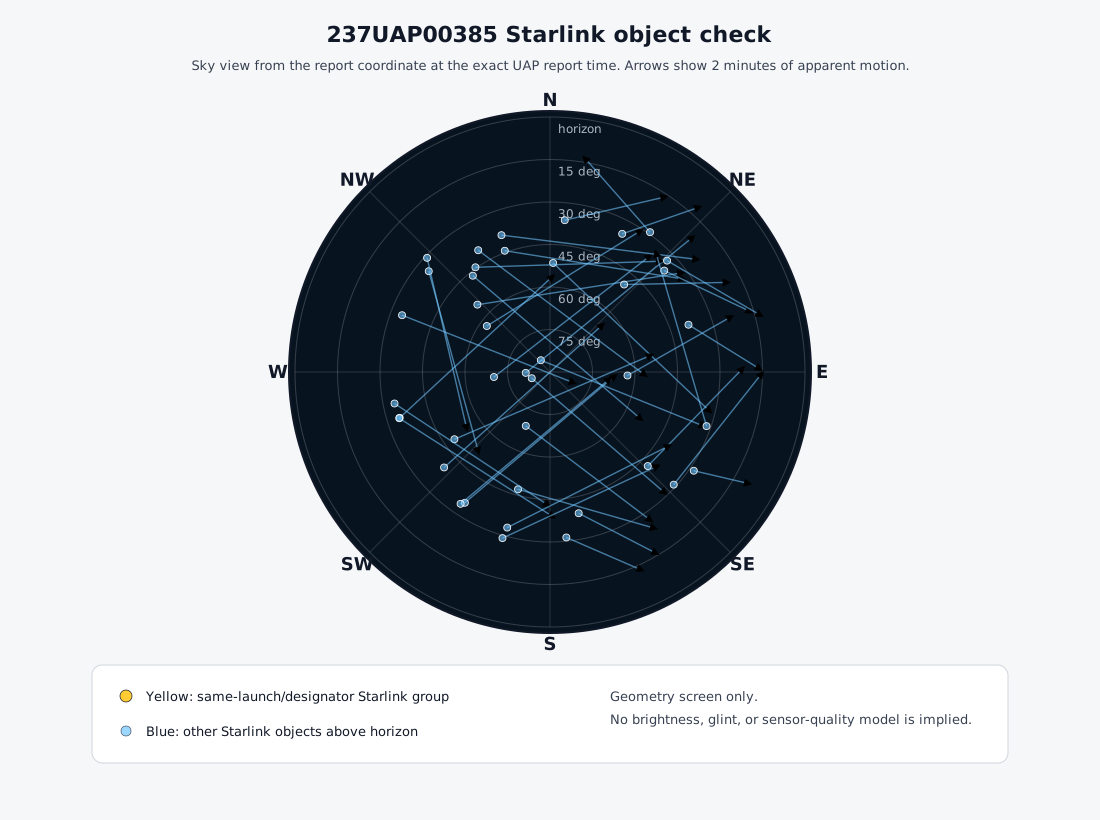
Generated figure copied from the local evidence-plot output. It is included as an analytic visualization, not as original sensor imagery.
7. Analytic Comparison
Criterion
Report Evidence
Analytic Treatment
Time constraint
2024-10-22T01:54:00+00:00
Directly used in propagation; this is a hard filter, not descriptive context.
Location constraint
38.85440, -78.20560
Directly used as observer point for azimuth/elevation/range computation.
Count / pattern
not explicit
Primary same-launch group contains 3 propagated objects in a compact sky sector.
Motion language
stationary
Apparent motion labels in the object table provide a plausible but not definitive comparison.
Radar / official check
not observed on ATC radar
No ATC radar return can be consistent with distant orbital objects or visual aircraft-light hypotheses, but it does not prove the match.
Analytic disposition
normal-object
237UAP00385 is assessed as normal-object favored because the available public evidence gives a case-specific ordinary-object candidate: strong ADS-B aircraft candidate N957NK A20N ad4fde at 0.5 km, azimuth 57.6 deg, elevation 86.57 deg, 6.87 min from report. Dense satellite presence alone is not treated as causation in this packet.
8. Caveats, Limitations, and Collection Gaps
No raw cockpit video, ATC replay, radar plot, or witness interview transcript was reviewed unless explicitly stated in the public source text.
Aviation-derived coordinates can represent a nearby fix/radial or report point, not necessarily the actual line-of-sight intercept point.
Starlink visibility depends on illumination, observer altitude, atmospheric conditions, and apparent brightness; this analysis tests geometry, not photometry. No brightness model is used unless explicitly stated elsewhere in the case file.
TLE propagation is appropriate for screening and reconstruction but is not a substitute for authoritative operational ephemerides.
When many satellites are above the horizon, generic presence is weak evidence and is not treated as causation. The report emphasizes named launch-object checks or compact same-launch trajectory groups.
Normal-object favored is not the same as a perfect named-object identification; it requires a case-specific ordinary-object candidate stronger than simple object density.
Appendix A. Public Report Text Extracts
237UAP00385
SKYWATCH INCIDENT REPORT


PRIMARY CODE: UNIDENTIFIED AERIAL PHENOMENON
Date: 01:54 10/22/2024                      Callsign: EDV4925                          Origin: LGA
Status: Closed                              Aircraft: CRJ9                             Destination: CHA
POD: DEN                                    Tail Number:                               New Destination:
Reporting Facility: ZDC                     Operator: EDV                              Operator Type: Commercial
                                                                                       Paged: YES


REMARKS

Aircraft reported an unidentified aerial phenomenon off the left side while SW bound at FL360, over LDN. The unknown
phenomenon was bright white and yellow flashing lights, stationary at approximately FL500 to FL600. The UAP was not
observed on ATC facility radar system.


SKYWATCH INCIDENT REPORT | DATE: 2024-10-22T01:54 | POD: DEN | PAGE 1 of 1
Appendix B. Computational Evidence Digest
This appendix preserves the principal computed values used in the assessment, shortened to the fields most relevant to audit and review.
This checklist records which source layers were actually applied to this individual report. It separates checked evidence from unexhausted collection gaps so the disposition is auditable when the PDF is read alone.
Source Layer
Status
Case-Specific Note
NARA public UAP/FAA report
reviewed
Source IDs: 237UAP00385
Time and observer coordinate
extracted
2024-10-22T01:54:00+00:00 at 38.85440, -78.20560
Orbital object propagation
screened
Starlink
Space-Track SATCAT metadata
screened
33 NORAD IDs checked; 33 matched in local SATCAT subset
Launch-object/SupGP layer
not applicable
not a launch-object case
NASA/JPL known small-body layer
screened
CAD/Horizons secondary screen included when this case had NEO-relevant timing/geometry
NASA POWER/Horizons/DONKI context
not exhausted
Hourly weather, sky geometry, and space-weather context where local JSON is present
Nearest station visibility, cloud, wind, precipitation, and METAR observations
Weather/balloon source plan
planned
Nearest weather-airport, GOES, and radiosonde queries are listed where local plan JSON is present
Final analytic disposition
normal-object favored
Presence-only satellite density is context only; a stronger case-specific fit is required for normal-object disposition
References and Source Links
National Archives and Records Administration. Records Related to Unidentified Flying Objects (UFOs) and Unidentified Anomalous Phenomena (UAPs) at the National Archives.https://www.archives.gov/research/topics/uaps
National Archives Catalog. Records from the Federal Aviation Administration Relating to Unidentified Anomalous Phenomena, National Archives Identifier 493468575.https://catalog.archives.gov/id/493468575
Space-Track.org. Public source for the underlying U.S. Space Surveillance Network TLE distribution referenced by the historical TLE archive.https://www.space-track.org/